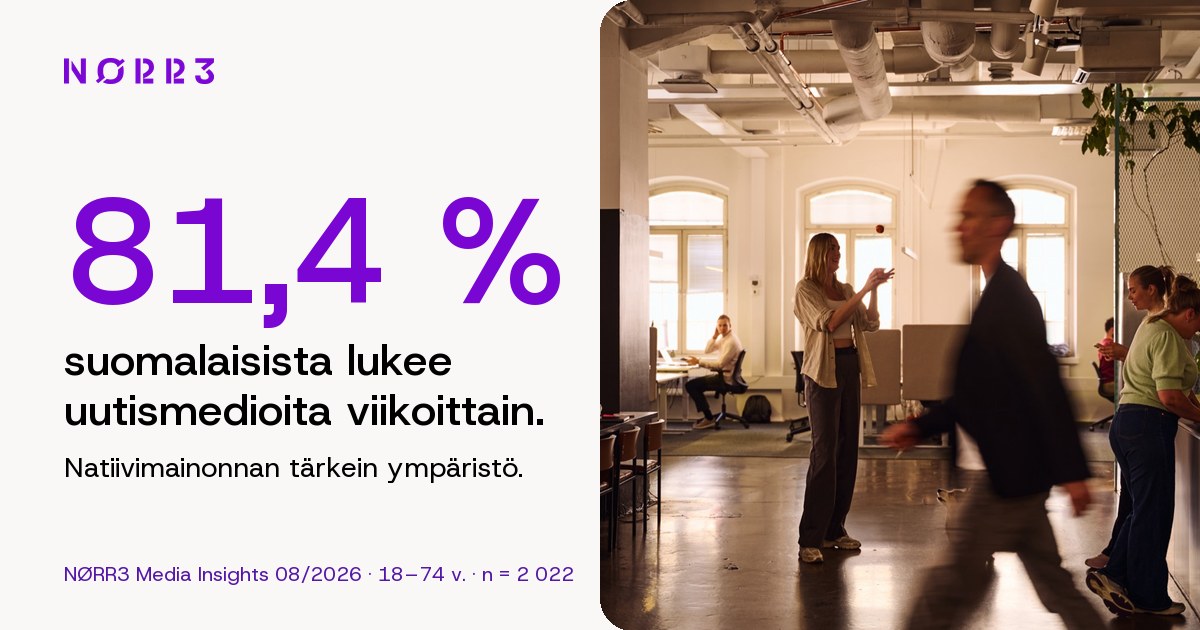
Native advertising is paid content published in the medium's own format and labelled as an ad. A typical form is a media owner's sponsored article in a news, business or magazine title. 81.4 % of Finns aged 18–74 read ad-carrying news media, where native ads most often run, in print or online at least weekly. The figure comes from NØRR3 Media Insights, August 2026.
This guide covers what native advertising is, how to buy it, how it differs from native ad formats, who it reaches, how it is labelled, what to consider now and when native pays off, including in B2B marketing.
What is native advertising?
A native ad looks and feels like the rest of the medium's content: an article on a news site or a video on the medium's video service. The difference is that the advertiser pays for it and often produces it together with the medium. That is why a native ad must always be labelled as an ad.
Common examples include:
- A sponsored article on a news site, such as an expert guide labelled as an ad with a link to the advertiser's site at the end.
- A print advertorial, a page made in the style of the publication's own stories and labelled as an ad.
- A sponsored video or podcast episode on the medium's own channel, labelled as an ad.
A well-known person or an influencer can appear in a native article, for example as an interviewee. A commercial collaboration published on an influencer's own social channels, however, is influencer marketing, not native advertising.
How is native advertising bought?
In Finland, native advertising is bought from Finnish media owners. A native campaign has two parts: the content itself and its distribution.
| Part | What it is | How it is bought |
|---|---|---|
| Content | A sponsored article, video or podcast in the medium's format | Agreement with the media owner, often produced with its content team |
| Distribution | Teasers and ads that bring readers to the content | As fixed visibility or per impression or click |
| In common | The content is always labelled as an ad | |
Finnish media owners usually produce the sponsored article with their own content team and sell its distribution as part of the same package. Distribution can be targeted by interest, region or professional group, for example. The price and buying method therefore depend on whether you buy only the content or its distribution too.
Native advertising in B2B marketing
When the audience is business decision-makers or professionals in a given field, native runs in business and trade media. Their readers are looking for information that supports their work, so a knowledgeable sponsored article fits naturally in that environment. Distribution can often be targeted by industry or professional group too.
B2B native that works is often an expert's point of view, research or a solution to an industry problem. Business purchase decisions often take time, so the article should answer the questions a decision-maker weighs before getting in touch. Native then does not sell directly: it builds expert reputation and puts the advertiser on the shortlist.
Native advertising and native ad formats
Native ad formats are often called native advertising too. They are ad placements that blend into the page layout, such as teasers that look like article links in a news site's listing, or programmatically bought native display ads. They are not content in themselves: they drive traffic. A native ad format can take the reader to the medium's sponsored article, to an article on the advertiser's own site or straight to a product page.
| Native advertising | Native ad format | |
|---|---|---|
| What you buy | Content labelled as an ad | An ad placement that blends into the page |
| What is produced | An article, video or podcast | Ad assets: image, headline and text |
| Where it leads | The content is the destination | The medium's article, the advertiser's own article or a product page |
| How it is bought | Agreement with a media owner | Per impression or click, also programmatically |
| Labelling | Both are labelled as ads | |
Choose the landing page by goal. An article suits a topic that needs explaining, a product page a reader who is already close to buying. When traffic goes to the advertiser's own site, reader numbers and the onward path show up in the advertiser's own analytics.
Native ad formats are sold by Finnish media owners and native networks, and programmatically they are bought on the same platforms as other programmatically bought media. Keep the difference in mind when planning: native content is content production and a media agreement, a native ad format is media buying.
Who does native advertising reach?
News media are the main environment for native advertising. 81.4 % of 18–74-year-olds read ad-carrying news media in print or online at least weekly, about 3.22 million people, and 49.0 % daily.
| News medium | At least weekly | People | Ad-addressable |
|---|---|---|---|
| Ilta-Sanomat | 56.4 % | 2 230 000 | 45.0 % |
| Iltalehti | 52.6 % | 2 081 000 | 42.0 % |
| Helsingin Sanomat | 33.2 % | 1 311 000 | 26.4 % |
| Helsingin Sanomat Visio | 16.7 % | 659 000 | 13.3 % |
| Kauppalehti | 10.1 % | 398 000 | 8.0 % |
| Aamulehti | 9.6 % | 378 000 | 7.6 % |
| Ad-carrying news media total | 81.4 % | 3 217 000 | – |
Source: NØRR3 Media Insights 08/2026 · Panel data Norstat · n = 2 022 · 95 % confidence interval ±1.3–2.2 pp. The total row covers 15 ad-carrying news media in print or online, margin of error ±1.7 pp. Ad-addressable = readers minus ad-blocker users. Ad-blocker users are not deducted from the total row. Many people read several media, so the rows do not add up.
Finns trust news exceptionally. In the Reuters Institute's 2026 report, 63 % of Finns said they trust news overall, against an international average of 37 %. Ads, on the other hand, are avoided: 68.6 % of Finns skip ads whenever they can, and 20.3 % use an ad blocker. That is why we calculate not only reach but also how many people are open to advertising.
Sources: Reuters Institute, Digital News Report 2026, Finland, 16 June 2026 · NØRR3 Media Insights 08/2026 · n = 2 022 · ±2.0 and ±1.7 pp.
The two tabloids each reach more than half of 18–74-year-olds in a week, but about one in five of their readers also uses an ad blocker. Plan native content so that it can also be distributed in other channels, such as social media or alongside display and video advertising. Business and trade media reach fewer people, but their readership is already narrowed down, which is an advantage in B2B marketing.
How is a native ad labelled?
A native ad is labelled clearly as "Mainos" (advertisement), and the advertiser must be identifiable. The same applies to print advertorials. The Finnish Competition and Consumer Authority (KKV) has a dedicated section on native advertising in its guidance on identifying advertising, and the guidance states that hidden advertising is never acceptable.
The wording of the label matters. In a US experiment only 7 % of readers (17 of 242) recognised a native article as advertising. Articles labelled "advertising" or "sponsored content" were seven times more likely to be recognised as ads than those labelled "brand voice" or "presented by". In Finland, the Council for Mass Media (JSN) has recommended that media use the label "Mainos" (advertisement) or "Kaupallinen yhteistyö" (commercial collaboration) together with the advertiser's name. These replace vague wording such as "in partnership".
In February 2025 the Council ruled against a publisher whose news app showed an ad among news items without labelling it as an ad, so it did not stand out clearly enough from journalistic content.
Sources: KKV, identifiability of advertising, read 17 November 2026 · Wojdynski & Evans, Journal of Advertising 2016 · JSN statement on labelling advertising 2015 (in Finnish) · JSN 9337/UL/24 (in Finnish), 12 February 2025.
What to consider in native advertising now
AI-generated content may need a label. The transparency obligations of the EU AI Act (Article 50) have applied since 2 August 2026. If native content uses a realistic AI-generated image, video or audio, this must be disclosed.
Distribution is part of a native campaign. On top of the media owner's own distribution, native content is often distributed through other channels too, for example native ad formats or social media advertising. Plan and budget the distribution together with the content itself.
Content lives in several channels. One native article can also work on social media, in a newsletter and in search results when it is written to answer the audience's questions.
When does native advertising pay off?
Native advertising suits topics that need explaining: a new service, a complex product or a decision the reader weighs for a long time. That is why it often works in B2B marketing too. It does not replace visible advertising but deepens it. Native's role and budget are decided alongside the campaign's other channels.
FAQ
What is native advertising?
Native advertising is paid content published in the medium's own format, such as a sponsored article in a news or business title. It is always labelled as an ad.
What is an example of a native ad?
A typical example is an expert article on a news site, labelled as an ad and paid for by the advertiser. Another is a sponsored video on the medium's own video service. KKV's guidance on identifying advertising explains the labelling in more detail.
What is the difference between native advertising and content marketing?
Content marketing is published in the company's own channels, such as its website or blog. Native advertising is paid for and published in the medium's channels, and it is labelled as an ad.
What is the difference between native advertising and a native ad format?
Native advertising is content labelled as an ad, such as a sponsored article or video. A native ad format is an ad placement that blends into the page layout, such as a teaser that looks like an article link. It takes the reader to the medium's sponsored article, to the advertiser's own article or straight to a product page.
Does native advertising work in B2B marketing?
Yes, when the content runs in media that business decision-makers and professionals read, such as business and trade media. B2B native that works is usually an expert's point of view or a solution to an industry problem.
How much native advertising is bought in Finland?
According to IAB Finland, media houses and native networks sold about 14.6 million euros of native advertising in 2024, about 7 % less than in 2023. The figure excludes the production of native content. No newer estimate has been published (as of 17 November 2026). Source: IAB Finland (in Finnish), 14 February 2025.
How many people see a native ad in news media?
81.4 % of 18–74-year-olds read ad-carrying news media in print or online at least weekly. 56.4 % read Ilta-Sanomat and 52.6 % Iltalehti, but because of ad blockers their ad-addressable reach is 45.0 % and 42.0 %.
Considering native advertising?
We tell you which native format and distribution suit your audience and how native works alongside your other channels.
About the author
Janne Savela, Senior Marketing Specialist, NØRR3
Janne has ten years of experience in media agencies, where his role has covered running digital campaigns, programmatic buying and display advertising more broadly. Over the years he has run campaigns for clients across a wide range of industries and in several markets, aiming at both tactical sales goals and brand growth. At NØRR3 he plans and runs programmatic campaigns.

Share
LinkedIn